Bet Percentage vs. Money Percentage: What NFL "Steam Moves" Actually Reveal
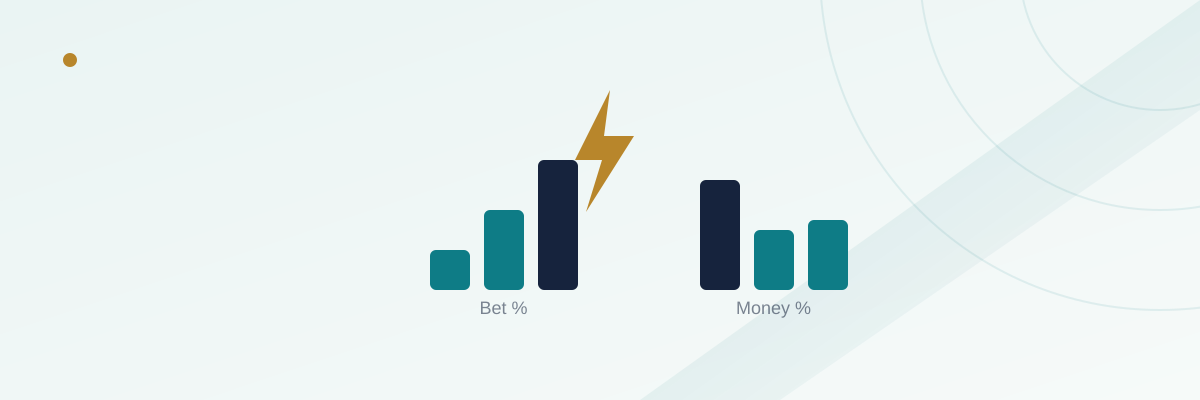
Open an NFL odds page during a busy Sunday slate and you'll sometimes see two different percentages sitting next to each other for the same game: one showing what share of individual bets (tickets) landed on each side, and another showing what share of total dollars wagered landed there. Most weeks those two numbers track each other closely. Some weeks they split hard, and that gap is one of the more genuinely useful free signals available to a bettor willing to learn what it does and doesn't tell you. This guide covers how the two percentages are counted, why they diverge, what a synchronized "steam move" actually is, and the mistakes people make trying to trade off this information.
In this guide
Bet percentage vs. money percentage: the real difference
Bet percentage counts individual wagers — tickets — regardless of size. Money percentage counts the actual dollar volume behind those wagers. A bettor putting $20 on a favorite counts exactly the same as a syndicate putting $20,000 on the underdog when you're tallying ticket count, but the two bets are nowhere near equal once you switch to counting dollars. That distinction is the entire story here.
Recreational, high-volume betting tends to spread across a large number of small tickets, and it leans in fairly predictable directions: favorites, overs, and marquee teams draw disproportionate ticket share almost every week. Larger, more selective bets — the kind associated with professional or "sharp" bettors — show up far less often in ticket count but can carry outsized weight in the money column. When bet percentage and money percentage point the same way, it usually means the crowd and the bigger money are roughly aligned, and a sportsbook is often comfortable holding the line where it sits. When the two diverge, it's typically because a comparatively small number of large wagers pulled the money share away from wherever the ticket count sits.
A worked example: an 80/45 split
Say a favorite is sitting at -3 and drawing 80% of all tickets, but only 45% of total money. That combination means most individual bettors like the favorite, yet the dollar volume is close to even, or even tilted toward the underdog once you account for the favorite's ticket share. The only way that math works is if the average wager on the underdog is considerably larger than the average wager on the favorite — a classic footprint of a smaller number of bigger, more selective bets landing on the other side.
That's often read as a hint that sharper money favors the underdog, and it's a reasonable one. But it's a probabilistic clue, not proof. Books sometimes let a split like this sit because they're managing liability across correlated markets — same-game parlays, teasers, alternate lines tied to the same game — rather than because a trading desk has concluded one side is "right." Treat the gap as one data point worth investigating, not a verdict.
Reverse line movement: when the number fights the crowd
Reverse line movement is the sharpest version of this signal. It happens when a line moves in the opposite direction from where the ticket majority sits — say, 70% of bets are on a -3 favorite, and instead of the price getting more expensive (which is what you'd expect if pure demand from ticket volume set the number), the line drifts down to -2.5 or -2. That direction only makes sense if the money behind the minority side is heavy enough to outweigh the crowd's ticket count.
Reverse line movement has been written about in betting literature for decades, which means it's also one of the more widely known signals in the market — plenty of bettors now try to spot and follow it deliberately, which arguably dilutes some of its predictive edge compared to when it was a more obscure observation. It still shows up regularly and is still worth watching; just don't treat it as a secret.
What a steam move actually is
A steam move is a fast, synchronized shift in the same direction across many sportsbooks within a short window, sometimes just minutes. The usual mechanics: a large, well-regarded bettor or syndicate hits a number hard at one or a handful of books; other books' pricing and trading operations notice the action (directly, through shared market-monitoring tools, or through vendors that supply lines to smaller operators) and move to avoid getting picked off at the old, now-stale number; and books that lean on a market-consensus price for their own line-setting update close to instantly once the bigger, sharper-facing books move.
It helps to separate a steam move from ordinary news-driven movement. An injury report, a weather forecast, or a late scratch usually has an identifiable, publicly known cause, and the market absorbs it gradually as the news spreads. A steam move is specifically about money forcing a reprice, often with no external news attached at all — which is exactly why it gets flagged as informative in the first place.
| Aligned split (high bet %, high money %) | Diverging split (high bet %, low money %) | |
|---|---|---|
| Typical read | Public and bigger money broadly agree | A smaller number of larger bets are pulling money share away from the crowd |
| Line behavior | Often keeps drifting toward the majority side | Can move against the ticket majority (reverse line movement) |
| Standalone signal value | Low — mostly confirms the obvious | Worth a closer look, still not a guarantee |
Where to find this data, and its limits
Some sportsbooks display bet and money percentage splits directly for popular markets, and a number of independent odds-tracking sites aggregate similar splits across multiple books. That data is genuinely useful, but it's incomplete by nature: what's published is usually drawn from one operator's action or an aggregated sample, not the entire national market, and any individual sportsbook's full internal liability picture stays private. Treat published splits as a useful proxy for market sentiment, not a complete ledger of where every dollar in the country actually sits.
Common mistakes when reading percentage splits
The most common error is treating every bit of line movement as a steam move. Most movement through the week is routine balancing — a book nudging a number a half-point because action is running slightly heavier on one side, nothing more dramatic than that. A second mistake is assuming a wide bet%/money% gap guarantees the money side wins; it shifts the odds in your favor of following informed money, but plenty of well-backed sides still lose outright. A third is chasing a steam move after it's already fully reflected across every book, expecting to still get the price that made the original move worth making. And a fourth is confusing a single retail sportsbook's public-facing splits, or an aggregator's sample, with the entire market's actual liability — a partial view of the picture, presented as if it were the whole thing.
None of this replaces basic bankroll and line-shopping discipline. For the fundamentals this sits on top of, see our guides on closing line value and how vig actually works.
Frequently asked questions
Is a steam move always caused by one very large bettor?
Not necessarily. It can also come from several sizable bets landing at similar books close together, or from multiple pricing desks reacting almost simultaneously to a shared market-monitoring feed — it isn't always traceable to a single identifiable whale.
Can a recreational bettor actually get the price that triggered a steam move?
Rarely the exact number, since the shift happens within minutes across books. Tracking which side a market steamed toward is still useful context for future decisions, even after you've missed that specific price.
Does reverse line movement always mean the sharp side wins?
No. It's a probabilistic signal, not a guarantee, and it's been publicly discussed long enough that it's arguably less predictive today than when it was a more obscure observation.
Are bet%/money% splits published for every NFL game?
Coverage varies by book and by aggregator. Marquee primetime and division matchups tend to get more publicly reported splits than lower-profile early-window games.